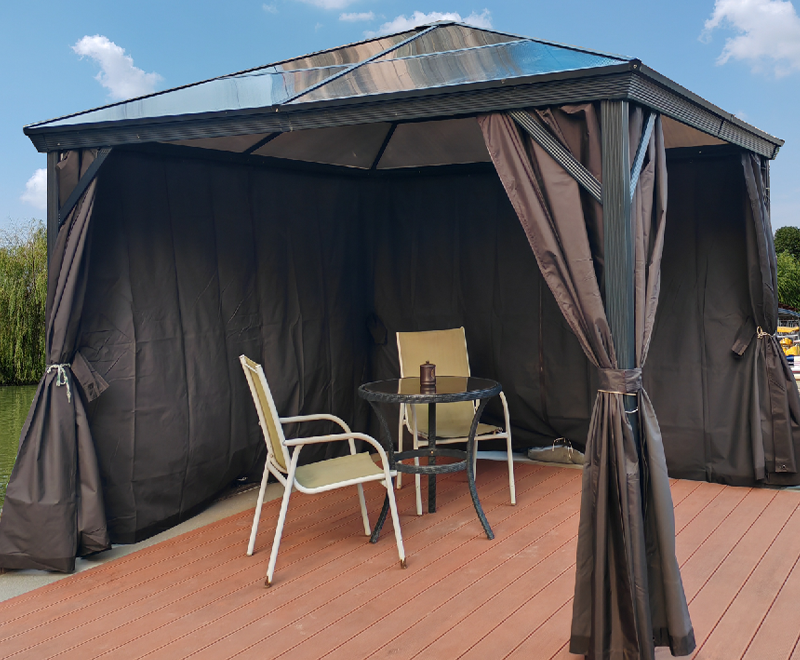
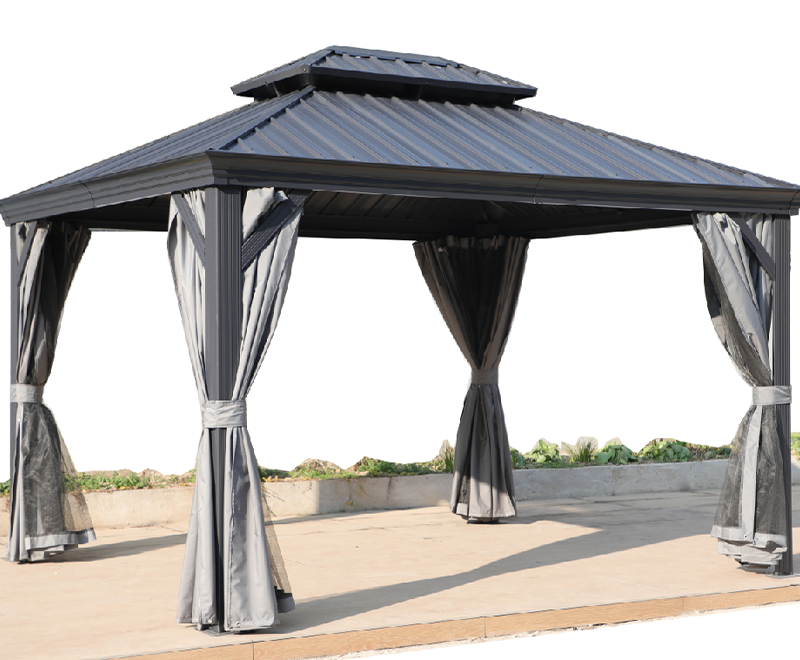
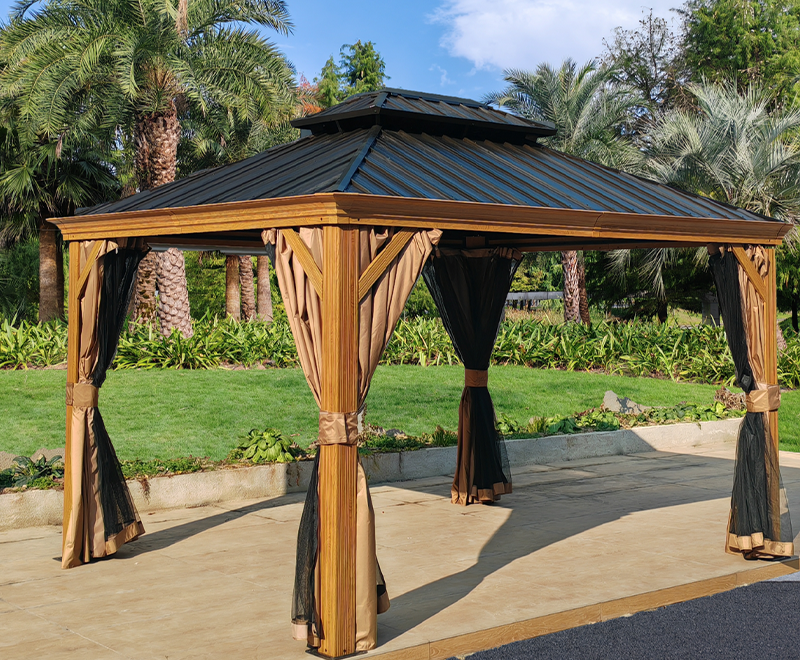
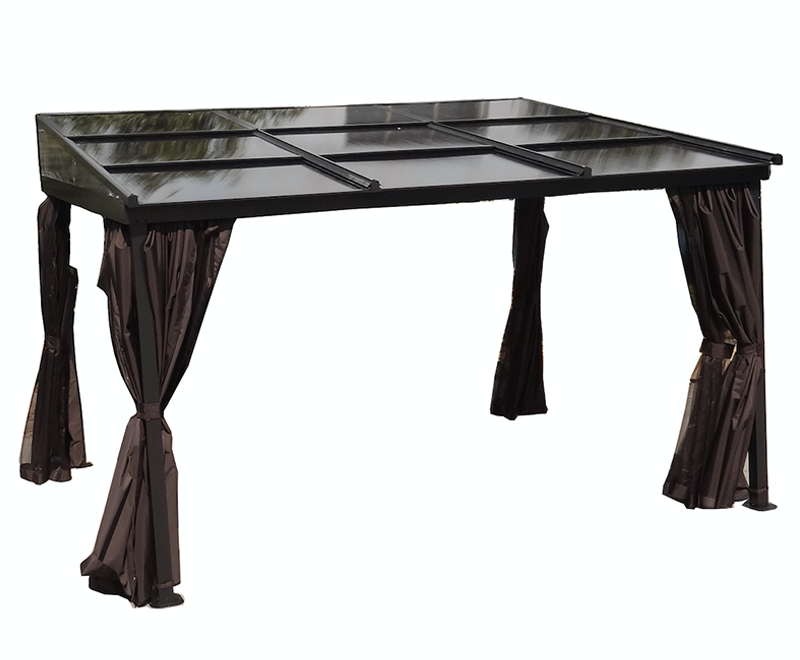
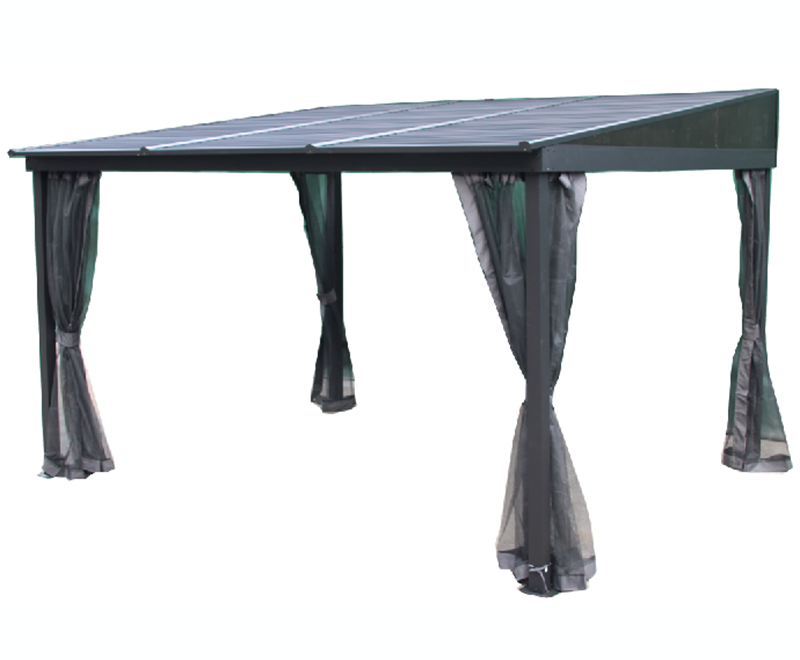
Yes — curtains, screens, and lighting are the three most impactful upgrades you can make to a hardtop gazebo, and most modern hardtop gazebo frames are specifically designed to accommodate all three. Many models ship with pre-drilled curtain rod channels, integrated mosquito net attachment points, and roof beam hooks or wiring channels for lighting. Done well, these additions transform a basic shade structure into a fully functional outdoor room that provides privacy, insect protection, ambiance, and year-round usability. This guide covers every option in practical detail — what works, what to avoid, and exactly how to install each upgrade.
Adding Curtains: Privacy, Style, and Sun Control
Curtains are the single most transformative aesthetic upgrade for a hardtop gazebo. They add privacy, soften the structural lines of the frame, block low-angle sun and wind, and create an enclosed room-like atmosphere that makes outdoor spaces feel genuinely intimate.
Curtain Rod Systems: How Attachment Works
Most contemporary hardtop gazebo frames incorporate one of three curtain attachment systems:
- Built-in curtain rod channels: A hollow groove or channel runs along the inside top edge of each side beam, into which a standard tension rod or proprietary curtain rod slides directly. This is the cleanest, most secure method — look for this feature in mid-to-premium models such as the Sunjoy Adelaide and YITAHOME Pro series.
- Pre-drilled hook points: Small holes or attachment studs at regular intervals along the top beam allow curtain rings or S-hooks to be clipped directly to the frame without any additional hardware.
- Aftermarket tension rods: For gazebos without built-in channels, spring-loaded tension rods (available in lengths up to 120 inches) can be wedged horizontally between posts at curtain height — no drilling required. Use rods rated for at least 10 lbs of curtain weight to prevent sagging.
Choosing the Right Outdoor Curtain Fabric
Not all curtain fabrics are suitable for outdoor use. Exposure to UV radiation, moisture, and temperature fluctuation rapidly degrades indoor fabrics used outside. Look for these fabric specifications:
| Fabric Type |
UV Resistance |
Water Resistance |
Privacy Level |
Best For |
| Sunbrella (solution-dyed acrylic) |
Excellent (rated 2,000+ hrs) |
Very Good |
High |
Full-time outdoor exposure, coastal areas |
| Polyester with UV coating |
Good (rated 500–1,000 hrs) |
Good |
High |
Most residential gazebos — best value option |
| Sheer outdoor voile |
Moderate |
Poor (decorative only) |
Low |
Ambiance and soft light diffusion in calm climates |
| Olefin / polypropylene |
Very Good |
Excellent (inherently hydrophobic) |
High |
High-rainfall climates, poolside use |
| Indoor cotton or linen |
Poor |
Poor (molds rapidly) |
High |
Not recommended for outdoor use |
Table 1: Outdoor curtain fabric comparison by UV resistance, water resistance, and privacy level
Curtain Sizing: Getting the Measurements Right
Incorrect curtain sizing is the most common mistake in gazebo curtain installation. Follow these measurements for a professional result:
- Width per panel: Each curtain panel should be 1.5–2× the width of the opening it covers to create natural fullness when drawn. For a standard 10×10 ft gazebo bay opening of approximately 8 ft, use two panels of 72–96 inches width each.
- Length: Measure from the curtain rod to 0.5–1 inch above the ground for a clean, floor-grazing look that minimizes wind billowing. Avoid puddle-length curtains outdoors — excess fabric on the ground traps moisture and debris.
- Standard gazebo curtain sizes: Most 10×10 ft and 10×12 ft gazebos use curtain panels of 54 inches wide × 84 inches long or 54 × 96 inches depending on eave height.
Curtain Tie-Backs and Wind Management
Outdoor curtains billow and wrap around posts in wind if not secured. Use magnetic tie-backs, rope tie-backs, or post-mounted cleats to hold curtains open when not in use. For windy locations, add curtain weights — small lead or steel weights sewn into the hem — to keep curtains hanging straight and reduce billowing. Hem weights are available on Amazon for $8–$15 per pack and can be added to any curtain panel.
Adding Screens and Mosquito Nets: Insect Protection Without Sacrificing Airflow
Mosquito netting and insect screens are among the most practical additions for anyone in a region with significant insect activity. They allow airflow and preserve the open feel of the gazebo while creating a fully enclosed, bug-free environment.
Mosquito Net Curtains vs. Fixed Screen Panels
- Mosquito net curtains (hanging mesh): Lightweight netting panels that hang from curtain rods or attachment points and overlap at the center for walk-through access. Easy to install and remove, inexpensive ($30–$80 for a full set), and suitable for most residential gazebos. Look for mesh with a pore size of 1.2 mm or smaller to block mosquitoes, gnats, and no-see-ums effectively.
- Fixed fiberglass insect screen panels: Rigid screen panels framed in aluminum that attach permanently to the gazebo's side openings. More durable than hanging nets, completely seamless, and more effective at blocking insects. Typically require custom sizing or professional fabrication — budget $150–$400 per panel for custom aluminum-framed screens.
- Retractable screen systems: Spring-loaded screens that roll up when not in use, similar to a window blind. Premium option at $200–$600 per side but offers the most seamless transition between open and enclosed configurations.
Screen Mesh Types and What They Block
| Mesh Type |
Pore Size |
Insects Blocked |
Airflow |
Visibility |
| Standard fiberglass screen (18×16 mesh) |
1.4 mm |
Mosquitoes, flies, wasps |
Excellent |
Clear |
| Fine mesh / no-see-um screen (20×20) |
0.6 mm |
All above + gnats, midges, sand flies |
Good |
Slightly reduced |
| Solar screen mesh (80–90% shade) |
Variable |
Larger insects only |
Moderate |
Significantly reduced |
| Pet-resistant screen (polyester coated) |
1.4 mm |
Mosquitoes, flies, wasps |
Excellent |
Clear |
Table 2: Comparison of screen mesh types for hardtop gazebo insect protection by pore size and performance
Installing Mosquito Net Curtains: Step-by-Step
- Measure each bay opening — record width and height from curtain rod position to ground level for each of the four sides.
- Purchase or cut net panels — each panel should be 1.5× the bay width for adequate overlap when closed. Most standard gazebo net sets come pre-sized for 10×10 ft and 10×12 ft models.
- Attach curtain rods or use existing channels — install tension rods or slide net panels onto existing rod channels in the gazebo frame.
- Secure the bottom hem — use tent pegs, magnetic hem weights, or adhesive velcro strips at ground level to prevent the net from lifting in wind and creating gaps for insects to enter.
- Create an overlap entry point — on one side, leave two panels overlapping by at least 12 inches at center rather than using a zipper or tie closure, allowing easy walk-through access while maintaining an effective insect barrier.
Adding Lighting: Ambiance, Function, and Smart Control
Lighting is the upgrade that extends gazebo usability from daylight hours into evenings and makes the structure visible and inviting as a garden focal point after dark. There are five practical lighting approaches for a hardtop gazebo, each suited to different aesthetics and technical requirements.
String Lights and Festoon Lights
The most popular and easiest lighting option. LED string lights are draped across the interior roof beams or hung in a grid pattern from the ridge beam down to the corner posts. They require no electrical wiring — most modern LED string lights are solar-powered or plug into a standard outdoor outlet.
- For a 10×12 ft gazebo: Two 25-ft LED festoon strings draped in parallel across the roof beams provide warm, even coverage. G40 or S14 Edison-style bulbs at 2,700K color temperature create the most flattering warm glow.
- Attachment method: Use adhesive cable clips rated for outdoor use, or wrap strings around roof cross-beams — avoid staples or nails that can damage wiring insulation.
- Solar vs. plug-in: Solar string lights are convenient but deliver lower brightness (typically 0.1–0.5W per bulb) than plug-in equivalents (1–2W per bulb). For meaningful evening illumination rather than purely decorative effect, plug-in LED strings are significantly brighter and more reliable.
- Cost: A quality 25-ft outdoor LED festoon string costs $25–$60 — the most cost-effective lighting upgrade available.
Ceiling Fans with Integrated LED Lighting
An outdoor-rated ceiling fan mounted to the gazebo's central roof beam delivers both functional lighting and air circulation — the two things that make a gazebo comfortable on warm evenings. This is the most practical single upgrade for hot climates.
- Required ceiling height: Minimum 8 ft eave clearance with fan blades positioned at least 7 ft above the floor. Measure your gazebo's eave height before purchasing — many 10×10 ft entry-level models have only 7 ft eave clearance, which is insufficient for safe fan installation without a flush-mount design.
- IP rating requirement: Must be rated UL listed for damp or wet locations — standard indoor ceiling fans will corrode rapidly in an outdoor environment. Look for fans with a "wet-rated" certification for open-sided gazebo use.
- Mounting: Most hardtop gazebos have a central roof beam or ridge bar that can support a fan mounting bracket. Use a fan-rated electrical box (minimum 35 lb weight capacity) and ensure the mounting point is into a structural beam, not just into a decorative panel.
- Recommended products: Hunter Cassius 52-inch Outdoor (wet-rated, $120–$180), Minka-Aire Gyro 42-inch Outdoor ($150–$220) — both include integrated LED light kits.
Recessed LED Downlights
For a clean, architectural look without visible light fixtures, recessed LED puck lights or downlights can be surface-mounted to the underside of the roof beams or inset into the soffit area of premium gazebo models. This is the most polished lighting solution and works particularly well in modern, minimalist gazebo designs.
- Placement: Mount one 5W–7W LED puck light per corner beam, directed downward and inward, for even floor-level illumination across the entire gazebo area.
- Wiring: Requires running low-voltage wire along the inside of the roof beams — most aluminum gazebo frames have hollow beam profiles that allow wires to be routed internally for a clean finish.
- IP rating: Use fixtures rated IP65 or higher for exposed gazebo installation.
Solar-Powered Post Cap Lights
Decorative solar LED caps that fit over the tops of the gazebo's corner posts — no wiring required. They charge during the day and automatically illuminate at dusk, providing a soft ambient glow and clearly defining the gazebo's perimeter in the dark.
- Sizing: Measure the exact outer dimensions of your gazebo posts before purchasing — most standard aluminum gazebo posts are 2×2 inches or 2.5×2.5 inches. Post caps must match post dimensions for a secure fit.
- Output: Typically 5–15 lumens per cap — purely decorative, not suitable as primary lighting. Best used in combination with string lights or a ceiling fan fixture.
- Cost: $8–$20 per cap — a set of four for a standard gazebo costs $30–$80.
Smart Lighting Integration
For homeowners with smart home systems, gazebo lighting can be fully integrated with voice control, app automation, and sunset scheduling. The most practical approach is to connect plug-in string lights or a ceiling fan to an outdoor smart plug (compatible with Google Home, Amazon Alexa, or Apple HomeKit) — no rewiring required, and the entire gazebo lighting system becomes voice-controllable and schedulable within minutes.
- Recommended outdoor smart plugs: Kasa EP40 Outdoor Smart Plug ($22), Amazon Smart Plug with outdoor rating ($25) — both support dual outlets and automatic sunset/sunrise scheduling.
- Smart LED string lights: Govee and Twinkly both offer app-controlled outdoor LED festoon strings with full RGB color control, scene modes, and music synchronization — priced at $40–$90 for a 48-ft string.
Additional Customization Options Worth Considering
Beyond curtains, screens, and lighting, several other upgrades meaningfully expand a hardtop gazebo's functionality and comfort:
Outdoor Rugs and Flooring
An outdoor rug defines the gazebo floor space, adds warmth underfoot, and anchors the furniture arrangement visually. Choose polypropylene or recycled PET rugs with a flat-weave or low-pile construction — these dry quickly, resist mold, and can be hosed clean. For a 10×12 ft gazebo with a dining set, an 8×10 ft rug centered under the table provides the ideal coverage without extending to the posts where foot traffic would cause edge wear.
Privacy Screens and Shade Panels
For gazebos facing neighboring properties or high-traffic areas, rigid privacy screen panels — available in powder-coated steel, woven HDPE, or composite wood-look materials — can be attached to the gazebo posts to create permanent, maintenance-free privacy walls on one or two sides. HDPE woven screens provide 85–95% privacy blockage while allowing airflow, and are available in neutral colors that complement most gazebo finishes.
Side Wall Enclosure Kits
Several gazebo manufacturers offer branded polycarbonate or tempered glass sidewall panels designed to fit specific model frames — effectively converting an open gazebo into a three-season enclosed structure. The Palram Canopia Milano, for instance, offers optional twin-wall polycarbonate side panels that attach directly to the existing frame without modification, providing wind and light rain protection on enclosed sides while the system remains fully removable for summer use.
Heating Options for Year-Round Use
With curtains or screen panels installed to reduce drafts, a hardtop gazebo can be made comfortable in cool weather with supplemental heating:
- Freestanding propane patio heaters: Pyramid or mushroom-style heaters producing 40,000–48,000 BTU can heat a 10×10 ft enclosed gazebo comfortably in temperatures down to approximately 40°F (4°C). Maintain a minimum 24-inch clearance from curtains and roof structure.
- Electric infrared wall heaters: Mounted to the gazebo's post or beam, infrared heaters warm occupants directly without heating the surrounding air — more efficient in open or semi-open structures. A 1,500W electric infrared heater provides comfortable warmth in a 10×10 ft space at ambient temperatures above 35°F (2°C).
- Fire pit tables: A propane or natural gas fire pit table positioned at the center of the gazebo provides warmth, ambiance, and a functional surface simultaneously. Ensure adequate overhead clearance — a minimum of 36 inches from flame to roof structure is required for safe operation.
Customization Budget Guide: What to Expect to Spend
| Upgrade |
Budget Option |
Mid-Range Option |
Premium Option |
Impact on Usability |
| Curtains (full set, 4 sides) |
$40–$80 |
$100–$200 |
$300–$600 (Sunbrella) |
High — privacy, wind, sun control |
| Mosquito net curtains |
$30–$60 |
$70–$120 |
$200–$400 (retractable) |
Very High — insect-free use |
| String / festoon lights |
$20–$40 |
$50–$90 |
$90–$200 (smart RGB) |
Very High — evening usability and ambiance |
| Outdoor ceiling fan with light |
$60–$100 |
$120–$200 |
$200–$400 |
Very High — cooling and lighting combined |
| Solar post cap lights (set of 4) |
$20–$40 |
$40–$80 |
$80–$150 |
Low-Moderate — decorative accent only |
| Outdoor rug |
$40–$80 |
$100–$200 |
$200–$500 |
Moderate — comfort and aesthetic definition |
| Infrared patio heater |
$60–$100 |
$120–$250 |
$300–$600 |
High — extends season into autumn and winter |
Table 3: Cost ranges and usability impact for common hardtop gazebo customization upgrades